


WeChat ID
aaronpk_tv
-
 at Café Yumm!Beaverton, Oregon • Sat, June 5, 2010 1:45pmGetting some Yumm sauce! Yeaaahhhhh!
 -
-
@arielwaldman oh yea, I meant it was great to see you again and I hope you had a good time at @osbridge!
-
@arielwaldman YEAAAHHH!!
-
-
-
@andpoul My bad, didn't realize you were on that shared folder too.
-
Authentication Module for Apache (www.frogdot.org)
-
at P-I-EPortland, Oregon • Fri, June 4, 2010 12:35amstartup crawl post checkin.
-
Portland, Oregon • Fri, June 4, 2010 12:35amstartup crawl post checkin.
-
XAuth - an introduction on Vimeo (vimeo.com)
-
-
Portland, Oregon • Thu, June 3, 2010 8:51pmhacking on geoloqi with peeps
-
at JanrainPortland, Oregon • Thu, June 3, 2010 8:12pmstartup crawl
-
Portland, Oregon • Thu, June 3, 2010 8:10pmstartup crawl
-
On The Scene: On the map and in the future (www.oregonbusiness.com)
Cyborg anthropologist Amber Case and PHP developer Aaron Parecki presented one such project of their devising, a yet-to-be-released program called "Geoloqi."
Geoloqi will track a user’s location at all times, and use this data to provide various services. A user can leave himself a note to receive when he gets to a certain location, for example, a reminder to pick up batteries when he's in the store. The user can send a real-time map to a friend or client, to take the mystery out of when he or she will arrive. People meeting will know exactly what time to expect you if they know exactly where you are—you can even set up an automatic message to send to your boss if the software can tell you're going to be late for work.
One of the goals of Geoloqi is to automate a certain amount of existence. Case and Parecki seek to make the interface "ambient," that is, require very little actual interaction with the software in order for it to work. For example, if you set up Geoloqi to turn your lights on at your house when you arrive, you won't need to interface with the light switch. If you have an automatic alert that will give you the next bus departure time when you arrive at an airport, you won't need to seek that information out on your phone.
This may seem a bit creepy to you, but Parecki and Case are obsessed with this project. Parecki has been tracking his location using his Android phone for nearly two years. He has maps of his locations, color-coded by speed traveled. Using only data collected from his GPS locations, he has created maps of Portland and Eugene.
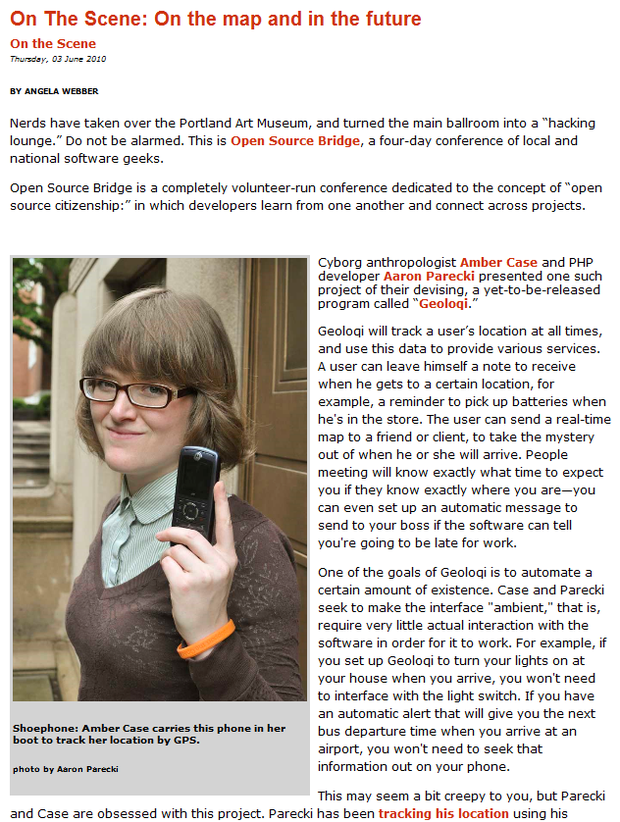
Case also carries a phone with her wherever she goes, to track her location. She actually has a phone expressly for this purpose—she is carrying it in her boot at Open Source Bridge.
With questions of security and privacy surrounding open source giant Google and closed-source giant Facebook, Geoloqi may seem like a scary and dangerous thing. But some may not mind so much, according to Don Park, another Portland software developer working on GPS projects.
"For a generation that has grown up posting to Facebook and Flickr, this isn't such a big deal." Park said that this generation even reaps the benefits of self-promotion through these digital means.
Case and Parecki, and the Open Source movement, are going mainstream sooner than you might think. Geoloqi will be beta testing this month, and Mayor Sam Adams gave the Open Source Bridge keynote this morning. The future, for better or worse, is now.
-
RT @natronics: The internet security talk is now spying on the facebook stalking talk #osbridge #osb10 #meta
-
What do you mean when you say you’ll be somewhere in five minutes? Are you actually five minutes away? Ten minutes? Still in the shower?
“Five minutes could be any amount of time,” says Amber Case, a cyborg anthropologist and about as close to a technology celebrity as Portland has. “That’s not even a real estimate of time.”
Now, Case and fellow PDX-based developer Aaron Parecki are close—like, superclose—to letting your phone do all of that hypothesizing for you. The two say they are weeks away from releasing Geoloqi, a mobile and web application that will quietly and constantly map your location and, if you’d like, tell your nearest and dearest where you are in real time.
2010-06-03 wweek geoloqi.png Here’s how it works: The application, designed the Android smartphone and iPhones equipped with the fourth generation operating system, runs in the background while you’re driving around or biking or whatever, taking GPS snapshots of where you are every so often and uploading those to a server. Those geo-locations can then be shared with friends, co-workers or whomever through a social profile.
The application is the culmination of months, if not years of work by the two developers—but Parecki in particular. Over the past months, Parecki has been using a GPS enabled phone to map his travels around the city, resulting in a massive Portland map filled with more than 10 million GPS points. The map shows not only location, but the speed he was traveling. The parking lots around Chinatown are solid black lines—you can’t go very fast when you’re hunting for a parking spot. Meanwhile, I-5 and the other highways around Portland are blurs of bright red—the result of GPS mapping at 50 miles per hour. Now, with Geoloqi, those maps of your location, and your speed, can help predict when you might show up somewhere—and let the person waiting know your ETA.
To hear Case and Parecki describe it, as they did yesterday at the Open Source Bridge conference, the uses for Geoloqi are multifold. Sure, you can tell a client when you’re stuck in traffic and running late to a meeting. But you can also tell friends when you’re on your way to the bar, sending an automated SMS message to their phones when you get within a certain range; automatically “check in,” Foursquare-style, when you show up at a certain place; if you have the right adapter, you can turn you lights off and on when you leave and return to your home—no switch required. And so on.
Plus, the application can communicate with you—the future you. If you need the future you to remember to pick up eggs at the store, you can leave yourself a geo-tagged note on a desktop map. Then, the next time you show up to the store, you’ll get a text message: Pick up eggs. If the future you will be traveling to a city you don’t know very well, leave the future you notes about what bus route to take, what the building your going to looks like, which restaurant to eat at. And of course, whoever you’re planning on meeting in this city can know when you show up. All in real time.
Knowing where someone is in real time can have real benefits, beyond just the coolness of knowing. Instead of waiting patiently for someone to show up, you can carry on with whatever else you’d rather be doing—playing Google Pac-Man or whatever—until a text message tells you they’re right outside. And rather than standing on some random street corner staring at your phone hunting for directions, texts with embedded maps will pop up on your phone, showing you exactly where to go without you having to search for it.
Of course, having others know where you are can be problematic, privacy-wise. You don’t want your boss to see that you’re at the Beavers game when you’re supposed to be sick in bed. You don’t want your ex to know where you are—ever.
Parecki says that’s exactly why the application has two ways to hide your information—according to both who you want to see it, and how long you want it shown for. For your friends, you can, in a sense, turn off your signal. Most of your friends don’t care to see where your are at all hours of the day, and vice-versa. For other people, like business for example, you can simply send out a link with to a map of your GPS data that expires whenever you want it to—in a half-hour, and hour and so on.
The principal is based in augmented reality—basically, the real world as enhanced by technology. Reality, as we know, is filled with interfaces. Every light has a switch. Every Foursquare check in requires you to poke at your phone in public for five minutes. But in the reality this application creates, all that goes away. Lights turn on when you pull in the driveway. You check in without every picking up your phone. With this, Parecki says, “you take away the interface. The interface becomes ambient.”